

2GIS Rating Changed. What Businesses Should Do With Reviews Now

Imagine a typical morning for a coffee shop owner. They open 2GIS and see: the rating has changed again.
Yesterday it was 4.8. Today, it's 4.7. There are hardly any new reviews, but dozens of old five-star ratings. “Why does one fresh three-star review weigh more than all the past year’s thanks?”
Because the 2GIS rating has long since ceased to be a simple arithmetic mean.
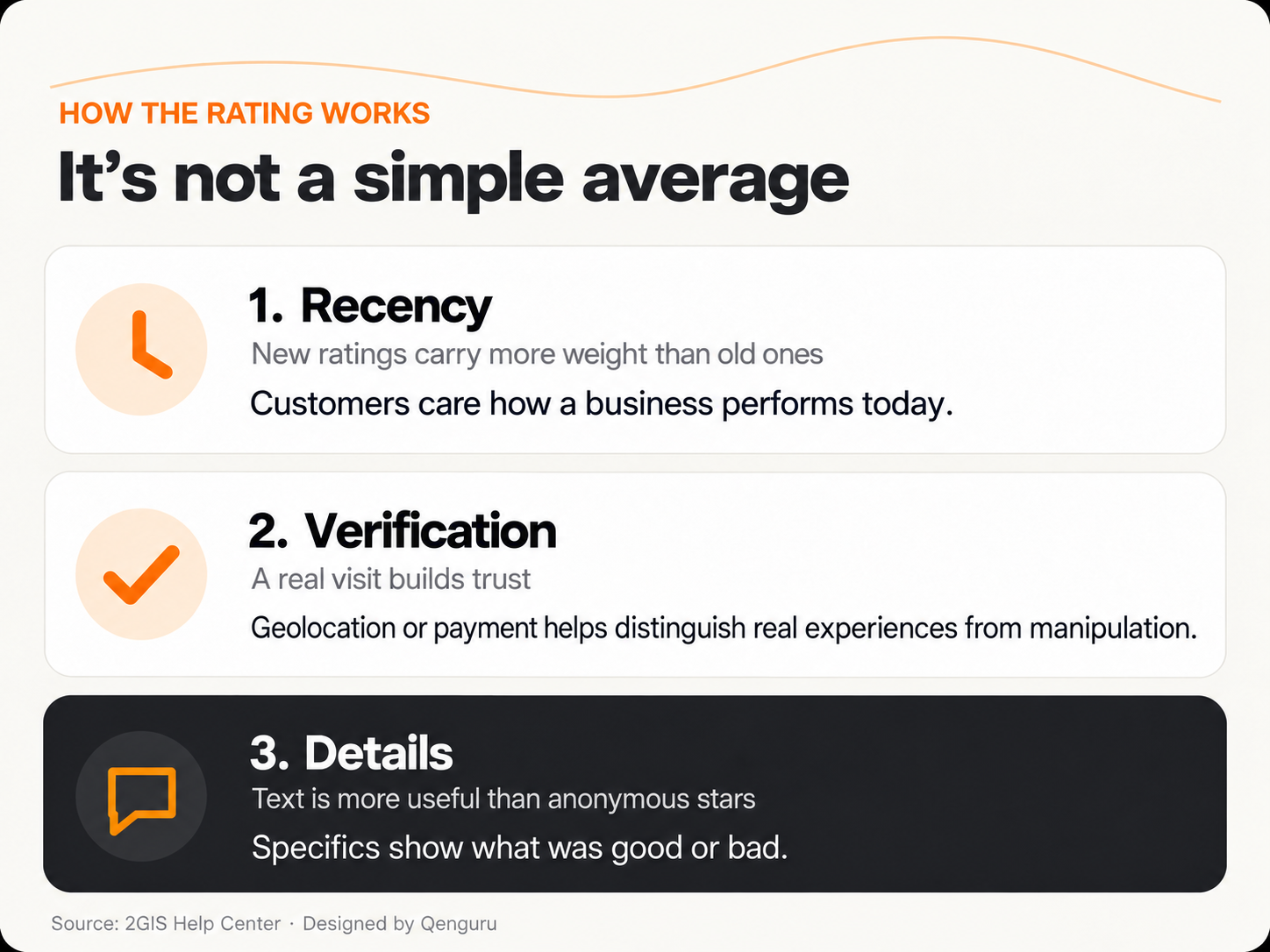
Three Rules for the New Game
First: recent ratings have a stronger impact than old ones. People want to know how the coffee shop is doing today, not two years ago.
Second: verified experiences weigh more. For example, when a visit is confirmed by geolocation or payment.
Third: a rating with text is more useful than bare stars. The phrase “the barista remembered my order” tells more about a business than another anonymous five-star rating.
This leads to an unpleasant but useful conclusion: you can't just collect reviews once and relax. Reputation here is like a storefront – you have to maintain it every day.
What's the Blue Checkmark About?
The blue checkmark tells the customer: this company really monitors its profile. You can't buy it — 2GIS assigns the badge automatically.
The conditions are quite straightforward:
- specify operating hours and contacts;
- upload at least five photos or one video;
- maintain an up-to-date price list;
- respond to at least 30% of reviews from the last six months;
- update data, price list, and media at least once every 100 days.
In a 2GIS test in one million-plus city, profiles with the checkmark received 11–13% more targeted actions after viewing. This is not a promise of growth for every company, but a signal: people feel more comfortable choosing a business that looks alive.
And here it's important not to confuse two numbers. 30% responses is a platform requirement. 100% meaningful responses is the standard for good service.
“Thank you for your review” — That's Not a Response Yet
Let's imagine the same coffee shop. A customer writes:
The coffee is good, but I waited almost twenty minutes for my order in the morning.
The company responds:
Thank you for your review! We look forward to seeing you again.
Formally, there is a response. But in terms of meaning, the customer wasn't heard.
A working response is built from four details:
- Address by name.
- A specific detail from the review.
- An actual response or action.
- Next step for the customer.
For example:
Marat, thank you for mentioning the wait in the morning. Twenty minutes is longer than our usual time. We will check the shift and the location's workload; if you write the date of your visit in a private message, we will look into your specific order. Coffee's on us.
Now, a future customer sees not a perfect business, but a business that knows how to correct mistakes. And that's more convincing than a flawless wall of identical five-star reviews.
Three Responses You Can Take Away
For a good review
Aigul, thank you for noticing [detail]. We will pass your words on to the team at [branch]. We look forward to seeing you again.
For a comment/concern
Dana, thank you for your honest feedback. You are right: [the essence of the problem] should not have happened. We have already [action]. If you write [safe detail] in a private message, we will look into your case.
When data is missing
Marat, we want to investigate, but we can't find the request based on the review. Please write the date and branch in a private message. Do not openly publish your phone number or payment details.
When There Are More Reviews Than Free Hands
One location gets five new reviews a week. A chain of twenty branches gets a hundred. The manager opens 2GIS “for ten minutes,” but an hour later is still copying responses.
Here, AI is not needed for mindless auto-publishing. It can collect new reviews, prepare a response based on the meaning, consider the branch and rating, and pass a contentious case to a human. For safe situations — automatic mode, for negative feedback and complaints — manager approval.
In Qenguru, you can configure both options, add a delay before sending, and receive reports via Telegram, WhatsApp, or email.
One-Day Checklist
- Check hours, contacts, and categories for all branches.
- Update the price list and add fresh photos.
- Calculate the percentage of reviewed responses for the last six months.
- First, process new negative feedback and customer questions.
- Approve templates, assign a person for contentious cases.
- Set a reminder to update the profile before 100 days expire.
The next morning, the coffee shop's rating may not rise. But the person who opens the profile before breakfast will see up-to-date information, live responses, and a company they can write to.
This is the essence of working with reviews: not to make the algorithm love the business, but to help the customer trust it.
Want to ensure no new review goes unnoticed? See how the Qenguru AI agent works with 2GIS reviews.