

Client wrote at 11:48 PM. By 11:51 PM, the appointment was in the calendar.

A typical Sunday evening. At 11:48 PM, a client texts the clinic on WhatsApp:
Can I come tomorrow after lunch? And how much does a primary consultation cost?
The AI agent replies immediately:
A primary consultation costs 25,000 ₸. Tomorrow after lunch, 3:30 PM and 5:00 PM are available. Which time is more convenient for you?
The client chooses 3:30 PM. The agent clarifies the branch, books the appointment, and sends a confirmation. By 11:51 PM, a new meeting is already in the calendar, and a deal is in the CRM.
At 9:07 AM, the manager starts their workday and sees not a “call back” request, but a confirmed appointment with the dialogue history.
The sale happened at night — without an on-call operator and without waiting until morning.
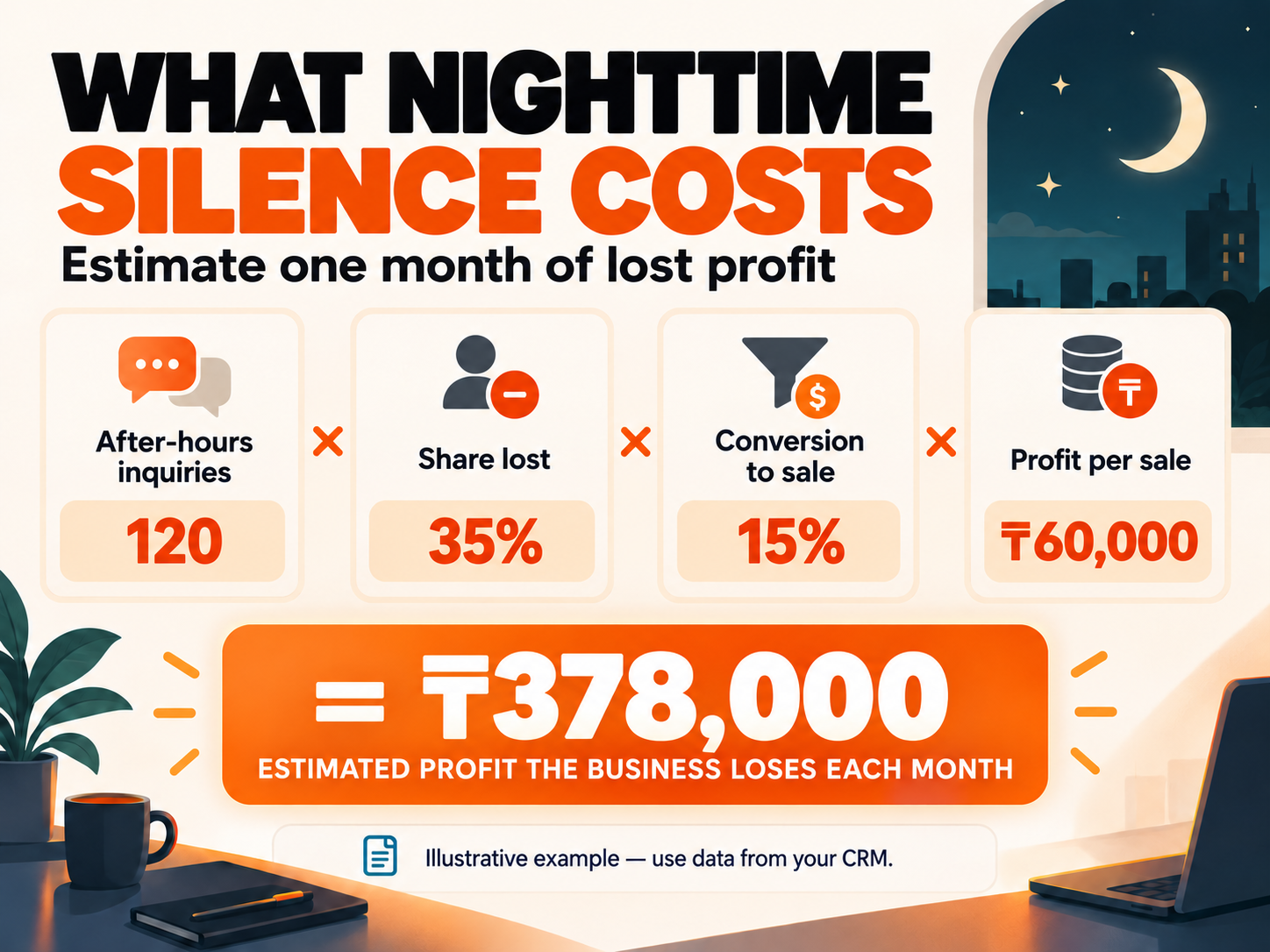
At night, you don't need an auto-reply, but a completed action
Usually, businesses limit themselves to a message like:
We are open from 9:00 AM to 6:00 PM. We will reply to you during business hours.
It's polite, but it leaves the person without a price, available time, or the opportunity to buy.
The effective night scenario looks different:
Message → understanding the task → consultation → offer → sale or appointment → CRM entry
If the question is standard and the data is in the database, the AI agent can bring the dialogue to a result independently. The manager connects not to every inquiry, but only where a human is truly needed.
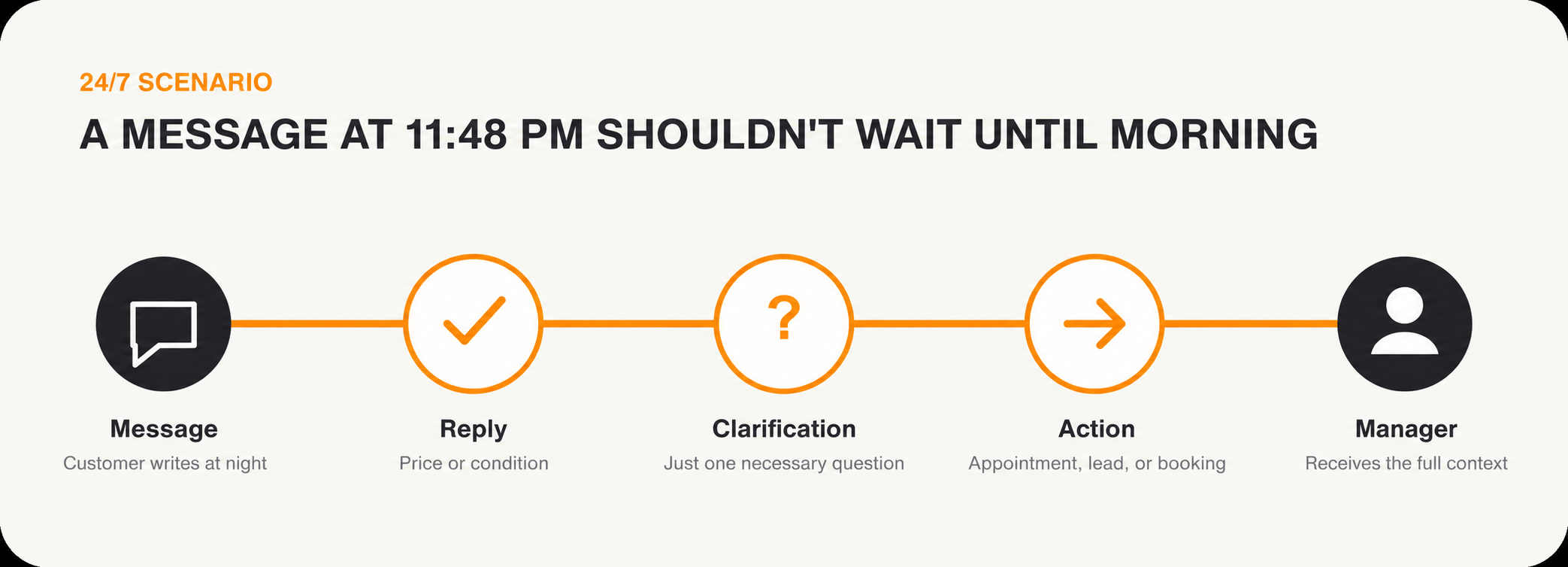
What the agent should do in the first three minutes
1. Introduce themselves honestly
Hello! I am an AI assistant for the clinic. I can tell you the cost, help you choose a service, and book an appointment right now.
2. Understand the task with a simple phrase
Clients shouldn't have to press seven buttons. “I need a doctor tomorrow after lunch” is already enough to determine intent.
3. Consult with verified data
The agent uses the current price list, schedule, and company policies. They explain the difference between options and address objections, but do not invent discounts or conditions.
4. Make an offer
Don't just state the price, but offer a suitable option and a clear choice:
A primary consultation costs 25,000 ₸. After 3:00 PM, two times are available: 3:30 PM and 5:00 PM. Which one should I book?
5. Close the sale
The agent can book an appointment or order, create a deal in CRM, send confirmation, and, if the scenario allows, a payment link.
If the necessary data is unavailable or the decision requires human responsibility, the agent honestly switches the scenario:
A specialist is needed here. I will save our conversation and forward it to the manager. They will connect before 10:00 AM — you won't have to repeat everything.
Night sales look different
- Clinic or salon — choose a service, specialist, and time, book an appointment.
- Educational center — select a course, tariff, and register for a trial lesson.
- Service company — calculate a standard service and arrange a visit.
- Online store — help choose a product, assemble an order, and send a payment link.
The goal is not to imitate a human. The goal is to eliminate the pause between the client's intent and the action that generates revenue for the business.
In the morning, the manager continues the sale, not starts it over
A bad morning starts like this:
Hello. How can we help you?
A good one starts with a CRM notification:
Aliya is booked for a primary consultation today at 3:30 PM, Abay branch. Cost confirmed, reminder sent.
The manager only needs to verify the appointment and connect if the client asked an unusual question. All history, needs, chosen service, and agreements are already saved.
Ready-made night scenario
Copy and adapt for your business.
First message
Hello! The team is currently offline, but I can help: choose a service, answer questions, and book an appointment. Write what you need in one message.
If the client is ready to buy
For your request, [service] is suitable. Cost — [price]. [Option 1] and [Option 2] are available. Which one should I book?
After selection
Done: you are booked for [service] — [date and time], [address]. I've sent a confirmation. If your plans change, write here — I'll help you reschedule.
If the client hesitates
I understand. The main difference between [option 1] and [option 2] is [verified difference]. For your task, I would suggest [option] because [reason from client's request].
If a human is needed
I will forward the question to a specialist along with our conversation. They will connect tomorrow before [time]. To prepare an accurate answer, please clarify [one necessary question].
If the client leaves to think
Okay. The dialogue is saved — you can continue here at any time, you won't have to repeat everything.
Where AI should stop
Not every dialogue should be fully automated. A human should be involved if it concerns refunds, payment errors, legal or medical consultations, strong negativity, security threats, or unusual large orders.
The rule is simple: routine to the agent, responsibility to the human.
Pre-launch checklist
- ☐ The agent identifies itself as an AI assistant.
- ☐ Sees current prices, services, and available slots.
- ☐ Understands Russian and Kazakh, English if necessary.
- ☐ Does not invent discounts or conditions not in the database.
- ☐ Can suggest a suitable option and answer typical objections.
- ☐ Creates an appointment, order, or deal in CRM without duplicates.
- ☐ Sends the client confirmation and the next step.
- ☐ Transfers only complex cases to a human, along with history and a summary.
- ☐ In the morning, the team sees completed sales and dialogues requiring attention.
Qenguru can manage such a scenario in WhatsApp, Telegram, Instagram, and on the website: respond 24/7, consult, sell, book appointments or orders, record deals in CRM, and connect a manager where a human is needed.
Let's return to the message at 11:48 PM. To get a sale, the clinic didn't need a night operator. It needed to state the price, offer two open slots, and book the chosen time.