

AI Agent in WhatsApp: What It Automates and How Much It Saves Businesses

At 9:05 AM, a training center owner opens WhatsApp. 47 messages have arrived overnight.
Previously, mornings began with a queue: "How much does it cost?", "Is there a spot after six?", "Can I get it in Kazakh?". While managers were responding, the hottest leads had already moved on to those who were faster.
Now, by 9:05 AM, the AI agent has already answered 31 common questions, scheduled six people for a trial lesson, created four deals in the CRM, and left two complex dialogues for the manager — with a brief summary and reason for handover.
This is a model example, not a result from a specific Qenguru client. But it highlights the main point: businesses don't buy "a bot that writes text." Businesses buy completed actions — appointments, orders, deals, and freed-up team time.
Not a Chatbot, but an Employee with Access to Processes
A regular chatbot guides customers using buttons. An AI agent understands free speech, mixed Russian and Kazakh, refers to a knowledge base, and acts according to business rules.
It can not only answer "appointment available" but also check the schedule, suggest a time, arrange an appointment, create a card in the CRM, and send a reminder. If a question goes beyond its authority, the agent hands over the dialogue to a human along with the context — the client doesn't have to repeat everything from scratch.
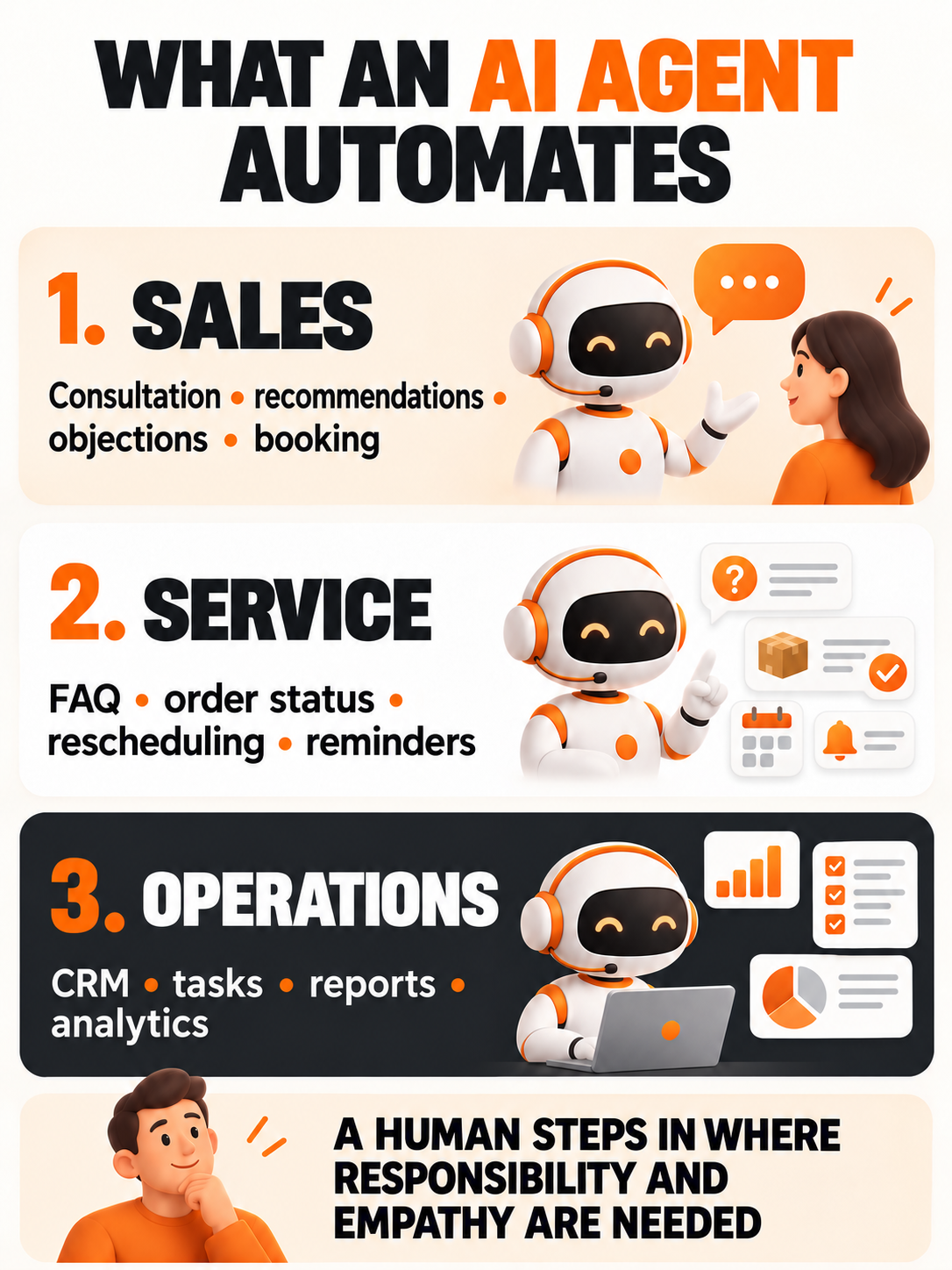
What Can Be Automated with Qenguru
Sales
- answer questions about price, availability, and terms;
- clarify needs and qualify leads;
- recommend a service or product;
- handle common objections;
- arrange appointments, orders, or applications;
- create deals and assign tasks to managers.
Service
- report order status;
- reschedule appointments according to defined rules;
- send reminders;
- close frequent questions from the knowledge base;
- collect missing data before specialist involvement.
Operations and Reputation
- update CRM and calendar;
- prepare summaries of inquiries and reasons for rejections;
- monitor new reviews in 2GIS and prepare responses;
- provide reports to management on leads, appointments, and unresolved issues.
Humans remain where responsibility and empathy are needed: unusual returns, conflicts, sensitive complaints, or decisions that cannot be made automatically.
Where Savings Come From
Savings don't appear because "AI replaced everyone." They are built from four things:
- managers don't retype the same answers;
- night and weekend inquiries don't wait for the start of the workday;
- data isn't manually transferred from chat to CRM;
- the volume of dialogues grows without a proportional increase in the team.
McKinsey estimates the potential impact of generative AI in customer operations at 30–45% of current function costs. This is a benchmark for assessing potential, not a promise of results for every company.
A large-scale example is Klarna: the company reported that its AI assistant processed two-thirds of inquiries and handled a volume of work comparable to 700 employees. According to Klarna's financial statements, cost savings for 2024 amounted to approximately $39 million. This is a self-assessment by a large international company, so it cannot be directly applied to small businesses — but it clearly shows the mechanics of the effect.
Calculate the Effect Using Your Own Numbers
A simple formula:
Team time savings + profit from recovered leads − AI agent cost
For example, a business receives 1,200 dialogues per month. If 65% of them are typical, and manual processing of one takes six minutes, that's 78 hours. At a full employee hourly cost of 3,000 ₸, up to 234,000 ₸ of working time is freed up.
Add 40 inquiries that arrive at night and on weekends. If a timely response brings 20% of them back into sales, and the profit per client is 25,000 ₸, the potential additional effect is another 200,000 ₸.
In total, in this example — 434,000 ₸ per month before deducting platform costs.
All figures above are illustrative. Copy the calculation and replace them with your own:
1. Time Savings = dialogues per month × share of typical × minutes per dialogue ÷ 60 × hourly cost.
2. Recovered Leads = inquiries outside working hours × conversion after quick response × profit per client.
Expected Effect = point 1 + point 2 − AI agent cost.
How to Test the Idea Without a Big Project
Don't start by automating the entire department. Take one frequent scenario, one channel, and one target action — for example, booking a consultation via WhatsApp with CRM deal creation.
Then conduct a pilot with real, anonymized dialogues:
- collect 30–50 chat transcripts;
- categorize them into "agent solves alone," "agent prepares and hands over," "human only";
- connect a knowledge base and one action in CRM or calendar;
- launch the pilot for 2–4 weeks;
- compare response speed, share of resolved issues, appointments, sales, errors, and cost per result.
Salesforce reports that 70% of surveyed service organizations using AI agents saw measurable value within 60 days. This is not a guarantee of ROI, but a good argument for a short pilot with pre-selected metrics.
Process Checklist for the First Pilot
Copy the list and mark the suitable scenario:
- ☐ repeats several times a day;
- ☐ answers are already available in the price list, regulations, or knowledge base;
- ☐ the dialogue has a clear outcome: appointment, order, status, or qualification;
- ☐ the necessary CRM, calendar, or accounting system can be connected;
- ☐ a process owner is assigned;
- ☐ it's clear when to transfer the conversation to a human;
- ☐ a business metric is chosen: time, cost per inquiry, conversion, or sales.
The next morning, the owner should see not a queue of messages, but results: who is booked, which deals are created, where a human is needed, and how much routine was lifted from the team.